Posts

Getting on HF

Image
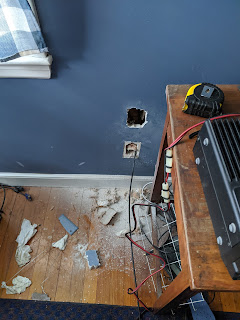
There's one thing I forgot to mention during my 2020 update. And it's important one at that. I was finally able to get on HF! Yes, during May 2020, me and my father went into the attic and hooked up the QuirkyQRP Slinktenna I have. It was quite the challenge as not all of the attic over the room where my station is has floorboards to step on, just studs. It also necessitated drilling a hole in the wall because despite our best efforts, the electrical fish tape kept falling behind the the metal junction box that was already in place in the wall. The hole in the wall that was drilled to properly snake the cable through the junction box below. The Slinktenna hung up behind an old TV antenna. Nevertheless, we persevered and I was able to start using HF via FT8. So far, SSB hasn't been successful but I believe that's due to the high noise floor I have. But still, I've had luck so far with FT8 and have made at least 20 QSOs so far with some QSL cards to boot. My station s...

A 2020 update

 Yes, I know. It's been a while since I posted, just under a year. Unfortunately, as we all know, 2020 is not a normal year.  Aside from attending the amateur radio training session for the 2020 Boston Marathon, the Marathon was delayed until September and ultimately cancelled and replaced with a virtual event. The same goes for the 2020 Head of the Charles Regatta.  I was planning on going to my first Hamvention , but that too was cancelled. As was the May and October editions of NEAR-Fest . My last hope for some ham action was the Northeast HamXposition , but alas, it was also cancelled. As have all the monthly MIT Fleas for the year. It's not all bad though, we've still had NSRA meetings via Zoom and continued them into summer, which usually is a break period for the club. Also, there have been virtual ham expos and fests online, such as the QSO Today Ham Expo and the HamXposition is going virtual too. I just recently got back from a 3 month work deployment on Na...

2019 Head of the Charles Regatta

Image
On Saturday, October 19th, 2019 and Sunday, October 20th, 2019, I participated as a volunteer in my first ever Head of the Charles Regatta, I visited the Regatta a few years prior to becoming a ham, but this was my first time being there long term. This was the fifty-fifth edition of the Head of the Charles, which first began in 1965. The Head of the Charles Regatta (HOCR) is the world's largest two day regatta. Outside of the major league team sports and the Boston Marathon, the Head of the Charles is probably one of the biggest sporting events in Boston. To quote rowing coach Susan Saint Sing: Regattas such as the Head of the Charles in Boston and the Head of the Schuylkill in Philadelphia are to the rowing world what the New York Marathon and the Boston Marathon are to running. Myself and two volunteers on a walking team. The job of the amateur radio operators at the HOCR is to be the radio communications for the volunteer first aid teams on shore and on the saf...

NEAR-Fest XXVI

Image
Last Friday and Saturday, I attended my first ever hamfest. NEAR-Fest stands for New England Amateur Radio Festival and is a hamfest that has been occurring every May and October at the Deerfield Fairgrounds since 2007. It was spawned from the ashes of a similar hamfest, The Hosstraders Tailgate Swapfest which had it's last event in October 2006. At our September meeting of the North Shore Radio Association , it was brought up that NEAR-Fest was just under a month and that something should be organized to sell off some of the silent key stash we had (including me with three boxes of books). At the end of September, on our usual Sunday night net, I called in via EchoLink to see if I could round up some help. Then a few days later, at the start of October, I posted on our Yahoo Groups mailing list to see if I could enlist some more help. In the end, the club treasurer, Eric, KA1NCF, a ham friend of his who lives down the street from him, Joel, N1KTH and myself went to ...

TSA's Radio Infrastructure

Image
As I mentioned in one of my earlier posts , I work for TSA, the Transportation Security Administration , the federal agency charged with protecting the nations transportation systems. Today, I'm going to give you a little overview of the agency's two-way radio systems. Sensitive Security Information Before I begin though, I must go over Sensitive Security Information or SSI . SSI is a designation used by TSA which is coded in federal regulation that states that SSI "is information that, if publicly released, would be detrimental to transportation security." SSI is essentially sensitive but unclassified information. As I work for TSA, I am automatically a "covered person" who is required to protect such information. Therefore, I am limited in what I can I use and say on anything that is considered SSI. However, most of the sources I'm using for this blog post are publicly available third-party sources which are not SSI or if it is a TSA source...

My own virtual scanner

Image
In February of this year, using a leftover Lenovo ThinkCentre M73 Tiny, that was original intended to be used a home theater PC, I made a "scanner" using it and 3 RTL-SDR USB dongles. All thanks to Luke Berndt's Trunk Recorder project . Trunk Recorder Trunk Recorder is open source software written by Luke, that using various SDRs such as the HackRF, RTL-SDR-based USB dongles and Ettus USRPs among others, allows the capture and recording of Project 25 (P25) and Motorola SmartNet trunked radio systems plus conventional systems that are P25 or analog too. It runs on Linux, macOS and even on a Raspberry Pi (although it's recommended to be a Pi 3 because the rest probably won't be able to keep up). You can either build it yourself from the source code or use Docker like I did to get it up and running. After configuring a JSON file that sets all the parameters for the instance you plan on running, a CSV file that defines the talkgroups you want to record, you...

Boston Marathon Amateur Radio Survival Tips

Image
I've participated in the Boston Marathon for the past two years and here's some survival tips for new hams. This is inspired by  W3ATB's original Survival Guide.  (Although it should be noted that the guide has been superseded by newer documentation.) Be prepared As the Scout Motto goes, BE PREPARED . The Boston Marathon is probably the preeminent public service event in all of amateur radio. (My opinion, of course.) Mind you, the course spreads over 26.2 miles from Hopkinton, Massachusetts to Boston, Massachusetts. You need to be prepared in various ways. 1.  Make sure your radio is programmed beforehand. Whether you have a top of the line Kenwood or a bottom of the barrel Baofeng or somewhere in between, make sure it is programmed with the various repeater and simplex frequencies before the event. Make sure you have the offsets and tones correct also. You don't want to be hand punching in frequencies and tones on the front panel at the volunteer meetup...